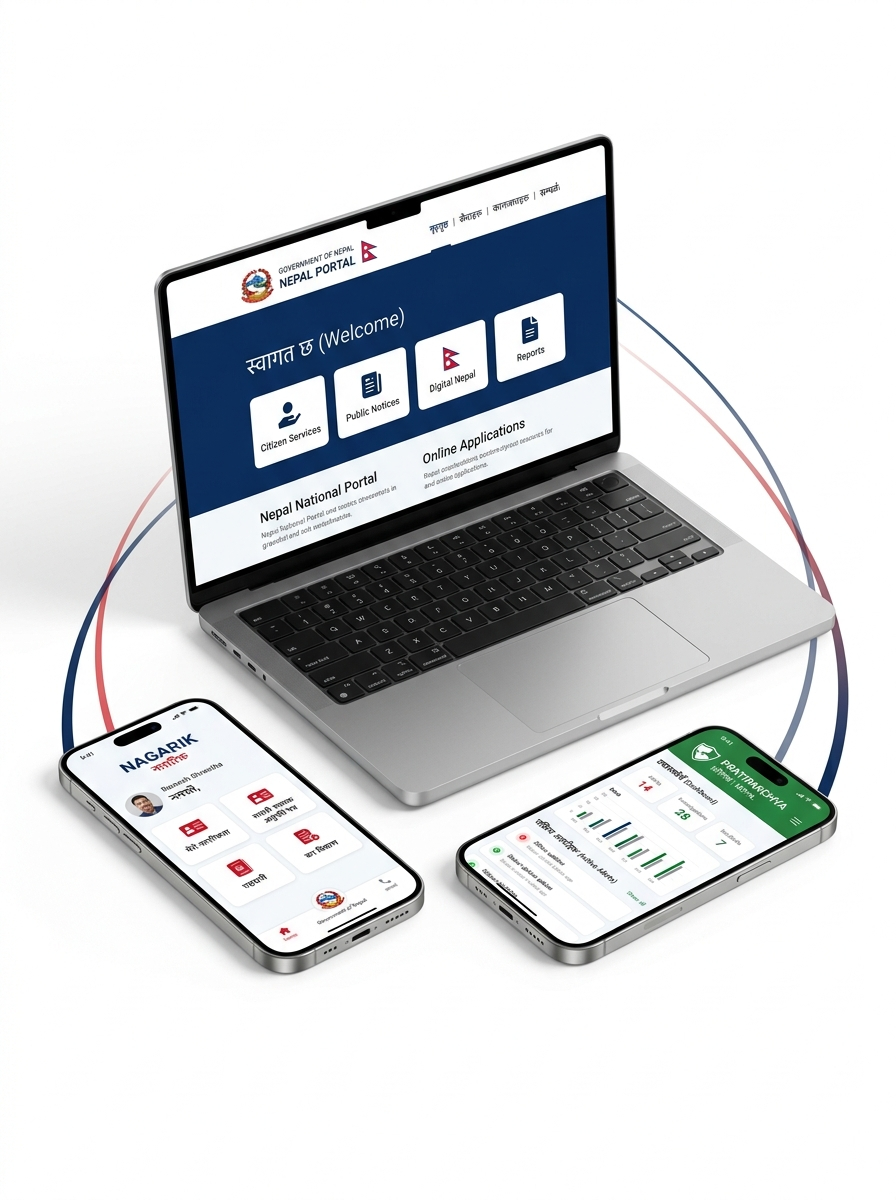
Nepal has a new Prime Minister. A 35-year-old rapper turned structural engineer turned mayor turned head of government. Balen Shah took his oath on March 27, 2026 — and within 48 hours, his cabinet had already released a sweeping 100-point governance reform agenda. One of its central pillars: full e-governance rollout. Faceless services. Digital delivery of passports, citizenship certificates, and driving licenses directly to your door. A government that actually wants to be online.
The interesting thing is — most of the infrastructure was already there. Nepal has built dozens of government websites and digital platforms over the last decade. Some are genuinely excellent. Some work reasonably well. A few are things most Nepalis have never heard of but absolutely should be using. And one of them went so viral it crashed its own servers.
I have been building digital products in Nepal for years — e-learning platforms, apps, web systems — so I spend more time than most people interacting with government portals, checking APIs, and understanding how Nepal's digital infrastructure actually works. This is my honest rundown of the 12 most important government websites in Nepal in 2026, what each one does, why it matters, and what Balen's digital reform agenda means for each of them.
Some of these you use every month. Some you will open for the first time today. All of them are worth bookmarking.
What Balen Shah's Digital Reform Actually Means for Nepal
Before getting into the websites, it is worth understanding what has changed in March 2026 and why it matters for Nepal's digital government landscape.
Balendra Shah — better known simply as Balen — won the 2026 general election with the largest vote margin in Nepal's parliamentary history, defeating former Prime Minister KP Sharma Oli in Oli's own stronghold of Jhapa-5 by nearly 50,000 votes. His Rastriya Swatantra Party (RSP) won 182 of 275 seats — the first parliamentary majority by a single party in Nepal since 1999. At 35, he is the youngest serving head of government in the world.
The 100-point governance reform agenda his cabinet announced on March 29, 2026 is not a vague vision document. It is a time-bound, ministry-by-ministry action plan with specific deadlines and accountability measures. On the digital side, the commitments include making the National ID the primary identity document for all government services, introducing a Government Courier Service to deliver passports, citizenship certificates, and driving licenses to citizens' homes within 100 days, building a national digital governance platform, and expanding e-signature use across all departments. For a country that still required citizens to queue at offices for documents that could easily be processed online, this represents a genuine shift.
The websites below are where that shift is happening — some of them already, some of them in the months ahead.
#1 — nepal.gov.np — The Official Gateway to Everything
nepal.gov.np is Nepal's official national government portal — the master hub that links to every ministry, department, constitutional body, and government service in the country. If you are ever looking for an official government website and you are not sure where to start, this is where you go first.
The portal organizes government information by ministry, by province, by service type, and by citizen need. You can find links to passport services, tax offices, education departments, health services, and more — all from a single starting point. It also publishes official government notices, policy documents, budget papers, and public procurement notices that are legally required to be made public.
Under Balen's reform agenda, nepal.gov.np is set to become the anchor of a unified national digital governance platform — where citizens can access services, track requests, verify documents, and interact with government without visiting an office. That transition has already begun. The portal now includes direct links to online service applications across dozens of departments, and the roadmap points toward a single-sign-on system linked to the National ID and Nagarik App.
It is not the most beautiful website in the world. But it is the most important government URL in Nepal, and every citizen should know it.
- ✅ Official gateway to all government ministries and departments
- ✅ Publishes government notices, tenders, policies, and budget documents
- ✅ Links to every province and local government
- ✅ Anchor of Balen's unified digital governance platform
- URL: nepal.gov.np
#2 — nagarikapp.gov.np — Your Government, In Your Pocket
The Nagarik App is Nepal's official digital citizen platform, developed by the National Information Technology Center (NITC) under the Ministry of Communication and Information Technology. It won the World Summit Award 2022 in the Government and Citizen Engagement category — selected from 180 participants globally — and as of 2025, over 1.5 million Nepali citizens actively use it.
The concept is straightforward: one app that holds all your verified government documents. Your passport details, National ID, citizenship certificate, driving license, voter ID, and PAN are all linked and verifiable through a single platform. Instead of carrying physical documents to every government office, bank, hospital, or verification point, you scan the app's QR code and the system verifies your identity digitally in real time.
In practice, adoption has been uneven. Traffic police in the Kathmandu Valley now accept digital licenses through the app's e-Chalan system — and they no longer confiscate physical licenses for traffic violations. Hospitals that initially rejected digital documents for health insurance verification have gradually started accepting them. The Inland Revenue Department allows PAN registration and tax verification through the app. Some banks accept the Nagarik App for KYC and even for opening accounts virtually.
The honest limitation — which the Kathmandu Post covered in March 2026 — is that legal mandates have not caught up with technology everywhere. There are still institutions that insist on physical documents even though the digital verification system is fully functional. Balen's 100-point agenda directly addresses this: making the National ID the primary identity for all government services means the Nagarik App becomes the legal standard for verification, not an optional convenience.
The app is available on Android and iOS. Registration requires your citizenship certificate and a verified mobile number in your name.
- ✅ Stores passport, NID, citizenship, driving license, voter ID, PAN
- ✅ QR-based digital identity verification in real time
- ✅ E-Chalan integration — traffic violations paid digitally, no license confiscation
- ✅ PAN registration and tax verification through the app
- ✅ Virtual bank account opening for selected banks
- ✅ World Summit Award 2022 winner — 1.5M+ active users
- URL: nagarikapp.gov.np
#3 — pratipakchya.com — The Site That Got 2 Million Views in 24 Hours
This one is not a government website. But it might be the most important website on this entire list for understanding how Nepal's government is actually performing.
Pratipakchya is an independent citizen accountability dashboard built by developer Bikram Adhikari. It went live on March 28, 2026 — the day after Balen Shah's cabinet released its 100-point governance reform agenda. Within 24 hours it had over 2 million views. That number tells you everything about how hungry Nepal's citizens are for real government accountability.
The site tracks every single one of the 100 action plan commitments made by the Balen government — the deadline, the current status, whether it is completed, in progress, stalled, delayed, or broken. Each commitment has its own page with a timeline, notes, supporting evidence, and related documentation. Citizens can see at a glance which promises the government has kept and which ones have quietly been forgotten.
The methodology is transparent. Commitments are tracked across five statuses: Not Started, In Progress, Completed, Stalled, and Broken. The tracker counts days elapsed, deadlines missed, and percentage of the agenda completed. It also has a public rating system and an MP portal where citizens can submit complaints directly about their elected representatives.
What makes Pratipakchya genuinely important — beyond the viral moment — is that it represents a new model of civic technology in Nepal. A single developer, working independently, built a transparency tool that is now used by hundreds of thousands of Nepalis to hold their government accountable. That is a precedent. Under Balen's stated commitment to open data and transparent governance, this kind of civic tech should only grow in 2026 and beyond.
A well-informed citizen is the strongest oversight a government can have.
- ✅ Tracks all 100 government commitments with live status updates
- ✅ Deadlines, timelines, evidence, and progress notes for each commitment
- ✅ Public rating system and citizen complaint portal
- ✅ Available in both English and Nepali
- ✅ 2 million views in 24 hours — most viral civic platform in Nepal's history
- ⚠️ Independent platform — not affiliated with the government
- URL: pratipakchya.com
#4 — immigration.gov.np — Visa, Passport, and Trekking Permits
The Department of Immigration manages everything related to entry, exit, and stay in Nepal — for both Nepali citizens and foreign nationals. For Nepalis, this is where passport applications, renewals, and related consular services originate. For international visitors, it is the official source for visa applications, visa extensions, visa conversions, and trekking area permits.
The portal publishes real-time data on how many people entered and exited Nepal's immigration checkpoints each day — a level of transparency that is unusual and genuinely useful for researchers and policymakers tracking tourism and migration patterns. The site also lists all subordinate offices, entry and exit points, contact information, and an interactive map of checkpoints across the country.
Under Balen's 100-point agenda, passport delivery is one of the most concrete commitments: a Government Courier Service for doorstep delivery of passports within 100 days of the government formation. That means citizens should no longer need to travel to the immigration office twice — once to apply and once to collect. If delivered, this is a significant quality-of-life improvement for the hundreds of thousands of Nepalis who apply for or renew passports each year, particularly those living outside Kathmandu.
- ✅ Passport application and renewal services
- ✅ Visa application, extension, conversion for foreign nationals
- ✅ Trekking permits — Restricted Areas, TIMS, ACAP, and more
- ✅ Real-time entry and exit data from all immigration checkpoints
- ✅ List of all offices, contact information, and checkpoint map
- URL: immigration.gov.np
#5 — ird.gov.np — Tax, PAN, and VAT — All Online
The Inland Revenue Department (IRD) is Nepal's tax authority — responsible for PAN registration, VAT registration, income tax filing, TDS management, tax clearance certificates, and enforcement of Nepal's tax laws. Every individual earning above the taxable threshold and every registered business in Nepal must have a relationship with the IRD. The good news is that almost all of it is now online.
The Taxpayer Portal at taxpayerportal.ird.gov.np allows individuals and businesses to register for PAN and VAT, file tax returns electronically, make tax payments online, download tax clearance certificates, and access their complete tax history. PAN registration is completely free, takes as little as one working day with NID linking, and can be done entirely online without visiting an office. As of April 2026, electronic TDS return filing is mandatory — paper filing is no longer accepted for most categories of deductors.
Nepal's VAT rate stands at 13% and has been unchanged since 1997. PAN registration is mandatory for all individuals earning above the taxable threshold, for all registered businesses, and for anyone wanting to open certain bank accounts, register property, or bid on government contracts. Operating without a PAN when legally required carries fines of up to NPR 100,000 under Section 117 of the Income Tax Act.
The IRD also publishes the PAN Search tool at ird.gov.np/pan-search — a free public service that lets anyone verify the validity of a PAN number and check a taxpayer's compliance status. Businesses routinely use this before making payments to vendors to confirm tax registration status and determine the correct TDS rate to apply.
- ✅ Free PAN registration — online, no office visit needed with NID
- ✅ VAT registration and VAT return filing online
- ✅ Income tax return e-filing and online payment
- ✅ TDS management — electronic filing mandatory from 2026
- ✅ Tax clearance certificates downloadable online
- ✅ PAN Search tool — free public PAN verification
- URL: ird.gov.np / taxpayerportal.ird.gov.np
#6 — Pension Management Information System — 352,816 Pensioners, Now Digital
This one is brand new and most people have not heard of it yet — which is exactly why it is on this list.
In April 2026, Finance Minister Dr. Swarnim Wagle launched the Pension Management Information System — Nepal's first fully digital pension renewal platform. Before this system existed, Nepal's 352,816 government pensioners — retired civil servants, teachers, Nepal Army, and Nepal Police personnel — were required to physically visit government offices or banks every year to renew their pension eligibility and continue receiving payments. For elderly pensioners, for people with disabilities, and for pensioners living abroad, this was a significant and often distressing burden.
The new system eliminates that requirement entirely. Pensioners can now log in to the official Pension Management Office website, navigate to the services section, and complete their annual renewal online from home — without visiting any office or bank. The government estimates that this change will reduce its annual commission payments to banks for pensioner verification and fund distribution to nearly zero, saving approximately NPR 150 million per year.
For a government that has committed to faceless, citizen-friendly digital services, this is exactly the kind of concrete implementation that matters. It does not make headlines the way Pratipakchya does, but for the 352,816 people it directly affects — many of them elderly, many of them living far from government offices — it is one of the most meaningful digital services launched in Nepal in recent memory.
- ✅ Online pension renewal — no office visit required
- ✅ Covers civil servants, teachers, Nepal Army, and Nepal Police retirees
- ✅ Launched April 2026 by Finance Minister Dr. Swarnim Wagle
- ✅ 352,816 pensioners now able to manage pensions from home
- ✅ Saves government NPR 150 million annually in bank commissions
- URL: Pension Management Office official portal
#7 — nrb.org.np — Nepal's Central Bank
Nepal Rastra Bank (NRB) is the central bank of Nepal and the apex monetary authority. Its website is one of the most accessed government sites in Nepal by professionals, businesses, researchers, students, and the general public — because it publishes information that affects nearly every financial decision in the country.
The most widely used feature is the daily foreign exchange rate — the official rate at which Nepali Rupees convert to US Dollars, Indian Rupees, British Pounds, Euros, and dozens of other currencies. These rates are published every working day and are the benchmark for all formal foreign exchange transactions in Nepal. If you are sending or receiving remittances, doing international business, or studying abroad, nrb.org.np is where you check the rate.
Beyond exchange rates, Nepal Rastra Bank publishes monetary policy statements, banking and financial institution regulations, interest rate corridors, inflation data, balance of payments reports, and the complete regulatory framework for Nepal's banking sector. Under Finance Minister Dr. Swarnim Wagle — who holds a PhD in Economics from the Australian National University and previously served as Chief Economic Advisor at UNDP for 36 countries — Nepal's monetary policy is under arguably the most internationally experienced oversight in the country's history.
For businesses, NRB publishes the list of licensed banks and financial institutions, their regulatory status, and compliance records. For researchers, the website's statistics section is one of the richest data sources on Nepal's economy. And for the general public, NRB's website is the reference point for understanding what interest rates to expect at banks, what the Rupee is worth internationally, and how Nepal's monetary policy is evolving.
- ✅ Daily foreign exchange rates — official benchmark for all forex transactions
- ✅ Monetary policy statements and interest rate decisions
- ✅ List of licensed banks and financial institutions
- ✅ Inflation data, balance of payments, and economic statistics
- ✅ Complete regulatory framework for Nepal's banking sector
- URL: nrb.org.np
#8 — dotm.gov.np — Driving License, Vehicle Registration, All Online
The Department of Transport Management (DoTM) handles all driving licenses, vehicle registrations, route permits, and transport-related regulatory matters in Nepal. The good news for 2026 is that the entire driving license process — from initial application to smart card print status tracking — is now fully digital through the DoTM online portal.
Applying for a new driving license starts at applydl.dotm.gov.np. You create an account with your mobile number, fill in your details (which auto-populate if your NID is linked), choose your vehicle categories, select your nearest DoTM office, and pick an appointment slot for biometrics and document verification. The system processes thousands of applications daily. After passing the written and practical trial exams, you receive an SMS when your smart card license is ready for collection — and you can track the print status online without calling or visiting any office.
As of 2026, Nepal's driving license validity has been extended to 10 years for applicants under 60 years old — a significant change from the previous 5-year validity. The smart card license contains your personal details, vehicle categories, validity period, and a QR code for real-time verification. Traffic police in Kathmandu Valley can verify your license digitally through the e-Chalan system integrated with the Nagarik App — meaning your physical license card is increasingly just a backup document.
The written test is computer-based at the DoTM office — 25 questions, with 13 correct answers required to pass. The practical trial test for Category B (car) involves a figure-8 course. For Category A (motorcycle), it is a narrow track test. You have three attempts within 18 months of your written exam. The entire process is transparent, trackable, and significantly faster than it was five years ago.
- ✅ Fully digital driving license application — no paper forms
- ✅ Smart card license with QR verification for real-time checks
- ✅ Online renewal, category addition, and fast print services
- ✅ 10-year validity for under-60 applicants (updated 2026)
- ✅ Online smart card print status tracking
- ✅ International Driving Permit available at Ekantakuna central office
- URL: dotm.gov.np / applydl.dotm.gov.np
#9 — kathmandu.gov.np — Where Balen's Digital Legacy Began
Before Balen Shah became Prime Minister, he was the Mayor of Kathmandu from 2022 to 2026. And the Kathmandu Metropolitan City website — kathmandu.gov.np — is where his track record of digital governance is most directly visible.
During his tenure, KMC became the first municipality in Nepal to live-broadcast its municipal council meetings — full transparency on every decision made at the city level. The administration launched e-Certificates and an e-Office system, allowing citizens to apply for ward-level documents and track their applications online instead of physically queuing at ward offices. Digital building permits reduced corruption in construction approvals by removing the human discretion that had previously allowed officials to delay or block permits for unofficial reasons.
The KMC website gives Kathmandu residents access to ward office contacts, local government services, budget documents, public notices, and project updates. For a city of over one million people dealing with rapid urbanization, the digital infrastructure that Balen built as mayor is now the template for what he wants to replicate at the national level.
If you live in Kathmandu and have never visited kathmandu.gov.np, you are missing out on a genuinely functional local government digital platform — one that is significantly more capable than most people assume.
- ✅ e-Certificates and e-Office system — ward documents applied online
- ✅ Digital building permits — transparent, reduced corruption
- ✅ Live-broadcast municipal council meetings
- ✅ Ward contacts, local services, budget documents, public notices
- ✅ Template for Balen's national digital governance rollout
- URL: kathmandu.gov.np
#10 — election.gov.np — Voter Identity and Election Transparency
The Election Commission of Nepal is the independent constitutional body responsible for conducting all elections in the country — local, provincial, and federal. Its website is where citizens check their voter registration status, verify their polling center, search for their name on the voter roll, and access official election results.
The March 2026 general election — the one that brought Balen Shah and the RSP to power with a historic majority — was conducted under the oversight of the Election Commission. The results, the candidate data, the constituency-level breakdowns, and the final seat allocations are all published on election.gov.np and remain publicly accessible as a permanent record of Nepal's electoral history.
For citizens, the most practically useful feature is the voter roll search. You can confirm whether your name is registered, which polling center you are assigned to, and whether your details are correct — and if they are not, the website provides the process for corrections and updates. With elections likely to continue being a major part of Nepal's political landscape under the RSP's governance, staying registered and informed through the Election Commission website is basic civic responsibility.
- ✅ Voter roll search — verify registration and polling center
- ✅ Official election results — all constituencies, all levels
- ✅ Candidate profiles and party data from all elections
- ✅ Voter registration correction and update process
- ✅ Constitutional body — independent from government
- URL: election.gov.np
#11 — neb.gov.np — SEE Results, Grade 12 Exams, and School Certification
Every student in Nepal who has sat for their Grade 10 SEE examination or their Grade 12 board exams knows this website. The National Examinations Board (NEB) is the autonomous government body responsible for conducting, managing, and certifying secondary-level examinations across Nepal — Grades 10, 11, and 12.
NEB was formed in 2073 BS (2016 AD) through the Eighth Amendment to the Education Act, integrating the previous Higher Secondary Education Board (HSEB) and the Office of the Controller of Examinations into a single body. It currently operates provincial offices in all 7 provinces and manages examinations across thousands of schools nationwide.
The website publishes exam routines, exam center details, result publication dates, and the results themselves — complete with full marksheets that students can download directly. SEE results in particular generate enormous traffic on neb.gov.np every year, as hundreds of thousands of Grade 10 students across the country check their results simultaneously. The site also handles school affiliation processes, grade sheet and transcript issuance, migration certificates, and scholarship program coordination.
An important security warning the NEB itself publishes prominently: enter your personal details only on the official website at neb.gov.np. There are dozens of unofficial third-party websites that mirror NEB content, some of which have been used to phish student data. The board has explicitly stated it never calls students or asks for money to change results.
Results can also be checked via SMS by sending NEB [symbol number] to 1600 on Nepal Telecom, or by dialing 1601 from any Nepal Telecom line.
- ✅ SEE (Grade 10) and Grade 12 results with full marksheets
- ✅ Exam routines and exam center details for all provinces
- ✅ Grade sheets, transcripts, and migration certificate services
- ✅ School affiliation and academic record management
- ✅ SMS result check — NEB [symbol] to 1600 on Nepal Telecom
- ⚠️ Only use the official site — neb.gov.np — for results and personal data
- URL: neb.gov.np
#12 — psc.gov.np — Government Jobs, Loksewa Exam, and PSC Results
For the hundreds of thousands of Nepali young people preparing for government service examinations every year, psc.gov.np is one of the most visited websites in the country. The Public Service Commission — Lok Sewa Aayog — is the constitutional body responsible for conducting all competitive examinations for appointments to government service positions in Nepal.
Kharidar. NASU. Section Officer. Under Secretary. The civil service examinations that these positions require are some of the most competitive in Nepal — drawing tens of thousands of candidates for a handful of vacancies. The PSC website publishes all vacancy notices, exam dates, exam centers, admit cards, written exam results, interview schedules, and final merit lists. Every step of the recruitment process for government jobs in Nepal runs through psc.gov.np.
Under Balen Shah's 100-point agenda, the civil service is being explicitly depoliticized — civil servants are being barred from political party membership, partisan trade unions in government offices are being abolished, and merit-based appointments are being enforced through key performance indicators. For aspirants preparing for Loksewa examinations, this is genuinely significant news: a government that is serious about merit-based appointments means that Loksewa preparation — real, substantive preparation — matters more than ever.
The PSC also conducts Teacher Service Commission (TSC) examinations for public school teachers, making it equally relevant to education professionals. The website publishes syllabus documents, old question papers, and model questions that are essential study resources for every serious Loksewa aspirant.
- ✅ All government job vacancy notices — Kharidar, NASU, Section Officer, and more
- ✅ Exam schedules, admit cards, and exam center details
- ✅ Written exam results, interview lists, and final merit lists
- ✅ Teacher Service Commission (TSC) examinations
- ✅ Syllabus documents, model questions, and old papers
- ✅ Constitutional body — independent from government ministries
- URL: psc.gov.np
All 12 Websites — Quick Reference
| # | Website | URL | Best For |
|---|---|---|---|
| 1 | Nepal Government Portal | nepal.gov.np | Starting point for all government services |
| 2 | Nagarik App | nagarikapp.gov.np | Digital identity, documents, e-Chalan |
| 3 | Pratipakchya | pratipakchya.com | Tracking Balen's 100-point commitments |
| 4 | Dept. of Immigration | immigration.gov.np | Passport, visa, trekking permits |
| 5 | Inland Revenue Dept. | ird.gov.np | PAN, VAT, tax filing, tax clearance |
| 6 | Pension Management System | pension.gov.np | Online pension renewal for retirees |
| 7 | Nepal Rastra Bank | nrb.org.np | Exchange rates, monetary policy, banking |
| 8 | Dept. of Transport (DoTM) | dotm.gov.np | Driving license, vehicle registration |
| 9 | Kathmandu Metro. City | kathmandu.gov.np | Ward services, e-certificates, KMC notices |
| 10 | Election Commission | election.gov.np | Voter roll, election results, voter ID |
| 11 | NEB | neb.gov.np | SEE and Grade 12 results, exam routines |
| 12 | Lok Sewa Aayog (PSC) | psc.gov.np | Government job vacancies, Loksewa exams |
Where Nepal's Digital Government Stands in 2026
Nepal's digital government is further along than most citizens realize. Driving licenses are fully digital. Tax filing is online. Pension renewal no longer requires standing in a bank queue. The Nagarik App holds your passport and NID in your pocket. And a single independent developer built an accountability dashboard that got 2 million views overnight — because citizens were ready for exactly that level of transparency.
The honest gaps are real too. Not every institution accepts digital documents even when the law and technology both support it. Website performance is inconsistent. Some portals still have significant UX issues that make them difficult for non-technical users. And the ambition of Balen's 100-point agenda will only translate into real change if implementation keeps pace with intention.
But the direction is clear. A government led by a 35-year-old who ran a fully digital mayoral campaign, who communicates primarily through social media, and who has explicitly committed to faceless digital service delivery — this is not a government that will be satisfied with slow e-governance adoption. The websites above are the infrastructure. The question of 2026 is how fast the services built on top of that infrastructure can reach every Nepali citizen, not just those who are already digitally literate and living in Kathmandu.
I will be watching closely — and I suspect Pratipakchya will be keeping score.
Frequently Asked Questions
What is the main government website of Nepal?
-
The main government portal of Nepal is nepal.gov.np. It serves as the official gateway to all government ministries, departments, and services — from passport applications to tax filing to public notices. Every government website in Nepal links back to this central portal.
What is Pratipakchya and why is it so popular?
-
Pratipakchya is an independent citizen accountability dashboard that tracks the Balen Shah government's 100-point action plan in real time. Built by developer Bikram Adhikari, it launched the day after the government's first cabinet meeting and got over 2 million views in 24 hours. Citizens use it to see exactly which government commitments are completed, in progress, delayed, or broken.
How do I apply for a driving license online in Nepal in 2026?
-
Apply through the Department of Transport Management portal at applydl.dotm.gov.np. The entire process — account creation, form submission, appointment booking, biometrics, written and trial exams, and smart card print tracking — is fully digital. Driving licenses for applicants under 60 are now valid for 10 years as of 2026.
What is the Nagarik App and who should use it?
-
The Nagarik App is Nepal's official digital citizen platform. It lets you store and access your passport, driving license, citizenship, National ID, voter ID, and PAN in one place, with QR-based real-time digital verification. It won the World Summit Award 2022 and has over 1.5 million active users. Every Nepali citizen should have it installed.
How can I check my SEE result in Nepal?
-
SEE results are published at neb.gov.np with full downloadable marksheets. You can also check by sending NEB [symbol number] to 1600 on Nepal Telecom, or by calling 1601. Only use the official neb.gov.np website — do not enter personal details on unofficial third-party result sites.
What is Balen Shah's digital reform agenda for Nepal?
-
Prime Minister Balen Shah's 100-point governance reform agenda — announced on March 29, 2026 — includes full e-governance rollout, a Government Courier Service for doorstep delivery of passports and citizenship certificates within 100 days, faceless digital service delivery across all departments, making the National ID the primary identity for all government services, and a national digital governance platform with real-time grievance systems.